ANC has been running a full creative services operation for years — real designers,
real deadlines, real clients. It has never carried a rate. This is what it looks like on the system,
and what it is worth.
Read off the live system 13 August 2026350 clients · 20,497 requestsEvery figure in mono comes straight off the system
← → to move
The position
$794,180
Creative work ANC delivered in the last complete year, priced at a blended
$85 an hour.
Invoiced to date: $0.
This is not a new line of business.
It is an existing one with no price on it. The designers,
the queue, the clients and the delivery record all already exist — audited below.
9,343 hours logged
April 2025 – March 2026, across 64 clients.
Logged time entries, not estimates.
The rest of this deck does three things: shows the operation is real, shows what
it sells alongside, and puts a number on the hour.
The operation
It already runs at scale.
350
Clients with design requests
20,497
Requests logged since 2023
30,148
Hours logged by the design team
133
Clients with hours against their name
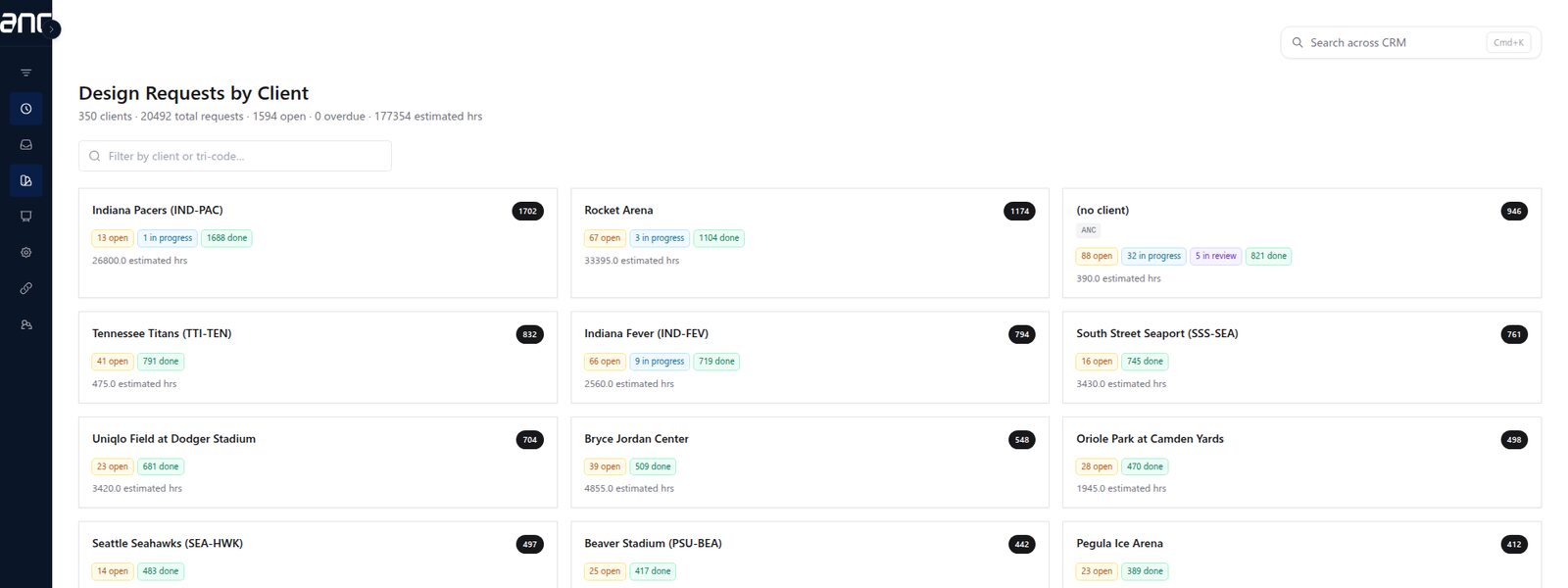
Design requests by client. Yesterday morning this board read 20,492 — five more have
arrived since. A live count, not a report.
The top of the list is a full studio's workload on its own.
Every one of those requests was scoped, designed, reviewed
and delivered. None of them carried an hourly rate.
Still running
And it is still taking work this week.
143
New requests in the last 30 days
377
In the last 90 days
1,554
In the last 12 months
1,599
Open on the board right now
Demand is not the thing to solve. The queue fills itself,
from the clients ANC already has.
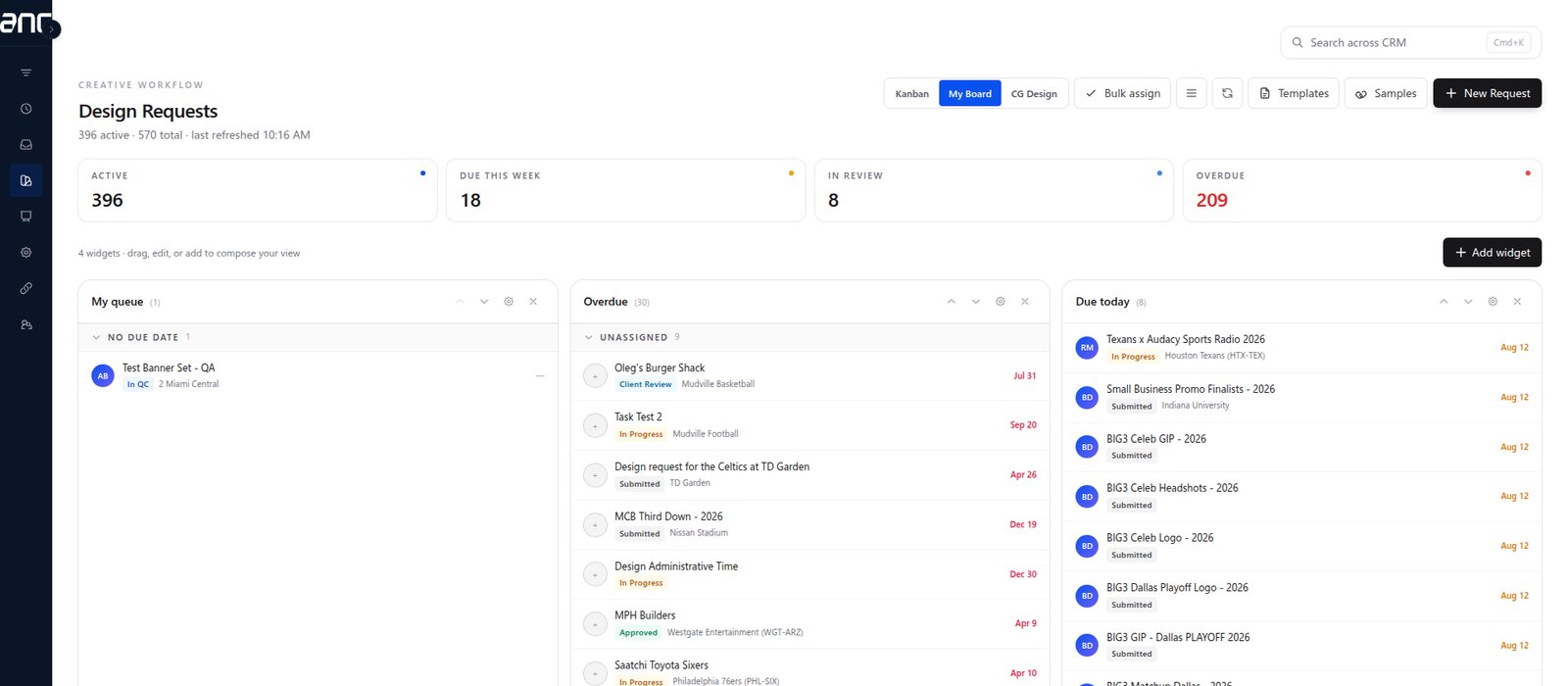
The designers' own board: 396 active in their working scope, 209 of them past due.
The hours
A full year of logged time, then a gap.
Hours logged by the design team, by month. The twelve
blue months are 9,343 hours — the year we would have invoiced.
Logged, April 2025 – March 2026 After the tracker cut-over
March 2026: 1,045 hours. August 2026:
3.8 hours — while
143 new requests came in. The work did not stop. The capture did.
The wedge
Everyone else ships video files. ANC ships the thing that makes them.
A conventional game-day package arrives as
a folder of finished clips, with every player name, score and sponsor painted into the pixels. The day
the roster changes, it goes back to the vendor.
A pre-rendered package
×Names and numbers are baked into the video
×A traded player means a new work order
×A new sponsor means the whole set is re-cut
×Score and stats can never be live
×You are quoted again every season
The ANC live package
→Every value is read from data at play time
→Roster changes appear on the next snap
→A sponsor swap re-brands the season in seconds
→Score, stats and matchup run off the live feed
→One build, then it is yours to run
That is the product the creative hours sell into — and the reason the
conversation is a season subscription, not a per-clip quote.
The proof
MetLife Stadium, 2026 game-day package.
Built on the boards ANC already runs. Thirty seconds,
sixty frames a second, original score, twelve templates cut from ANC's own material language —
the aluminium of the stadium facade. No stock footage anywhere in it.
2 min 12 sReal screens, no mock-upsEvery figure read off the live system
The second half of the film is the creative operation
itself — the same numbers on these slides, on the working boards.
The money
The gap is a price, not a build.
$85per design hour
$45$85$150
Recommended — $85 blended
$794,155
A year, on last year's delivered hours
$66,180
A month, across the client book
Three things are already true.
The hours are delivered. The clients are
under contract for other work. The per-client record exists.
A monthly statement per client is the invoice and the renewal conversation —
it puts a number in front of the client twelve times a year instead of once, and it does it with
work they already asked for.
At $85,
the design team pays for itself and funds the next two hires.
$15,245
The Indiana Pacers statement, every month — on 179.4 hours
of work ANC is already doing for them.
Move the rate. Every figure on this deck moves with it — including the client
statements on the next slide. Nothing here is baked in, which is exactly the pitch.
Who bills first
Eight clients carry it on day one.
Logged hours per client, April 2025 – March 2026, at
$85 an hour.
Client
Hours, the year
Hours a month
Monthly statement
These eight
A ninth line belongs third on this list and cannot be sent:
993 hours logged against no client at all.
That one is a data fix, and it is on the next slide.
Where to be careful
Say these out loud first.
Naming the weak spots is what makes the rest of the
numbers credible in the room.
01 · Estimates
Estimated hours are not an invoice.
177,354 estimated hours sit on the record, but only
962 of 20,497 requests carry an estimate at all,
and the figures are inconsistent between clients.
Use estimates as evidence of scale. Bill from logged time — the 9,343.
02 · Capture
Time capture stopped at the cut-over.
1,045 hours logged in March, 3.8 in August,
while 143 fresh requests arrived. The field is there; the habit lapsed
when the old tracker was retired.
Billing starts the month capture is back on. Nothing else blocks it.
03 · Attribution
CG work has no client on it.
572 of 633 control-room graphics requests
carry no venue and no client code, so they cannot be split per client — and neither can the
993 unattributed hours.
One clean-up pass on 572 records. Then CG bills like everything else.
None of the three is a build. All three are decisions or an afternoon of
cleanup — which is why the $794K is a pricing question, not a project.
The ask
Three decisions, thirty days.
01
Set the rate.
One blended hourly number for design and creative. Recommendation: $85, reviewed after two quarters.
Leadership This week
02
Turn capture back on.
Designers log hours against the request they are working. The field already exists on every request.
Design team Next Monday
03
Attribute the CG queue.
572 control-room records get a client and a venue, so CG hours land on a statement like everything else.
One cleanup pass Two weeks
→
Then the first statements go out.
Eight clients, one page each, monthly. Hours delivered, rate, total — and the next conversation.
Day 30
The business is already running.
What's missing is a price.
350 clients20,497 requests9,343 hours last year$0 invoiced